


Post-Extraction Complication
Dry Socket (Alveolar Osteitis)
What it is, how to spot it, and how to manage it — a guide for patients and referring dentists.
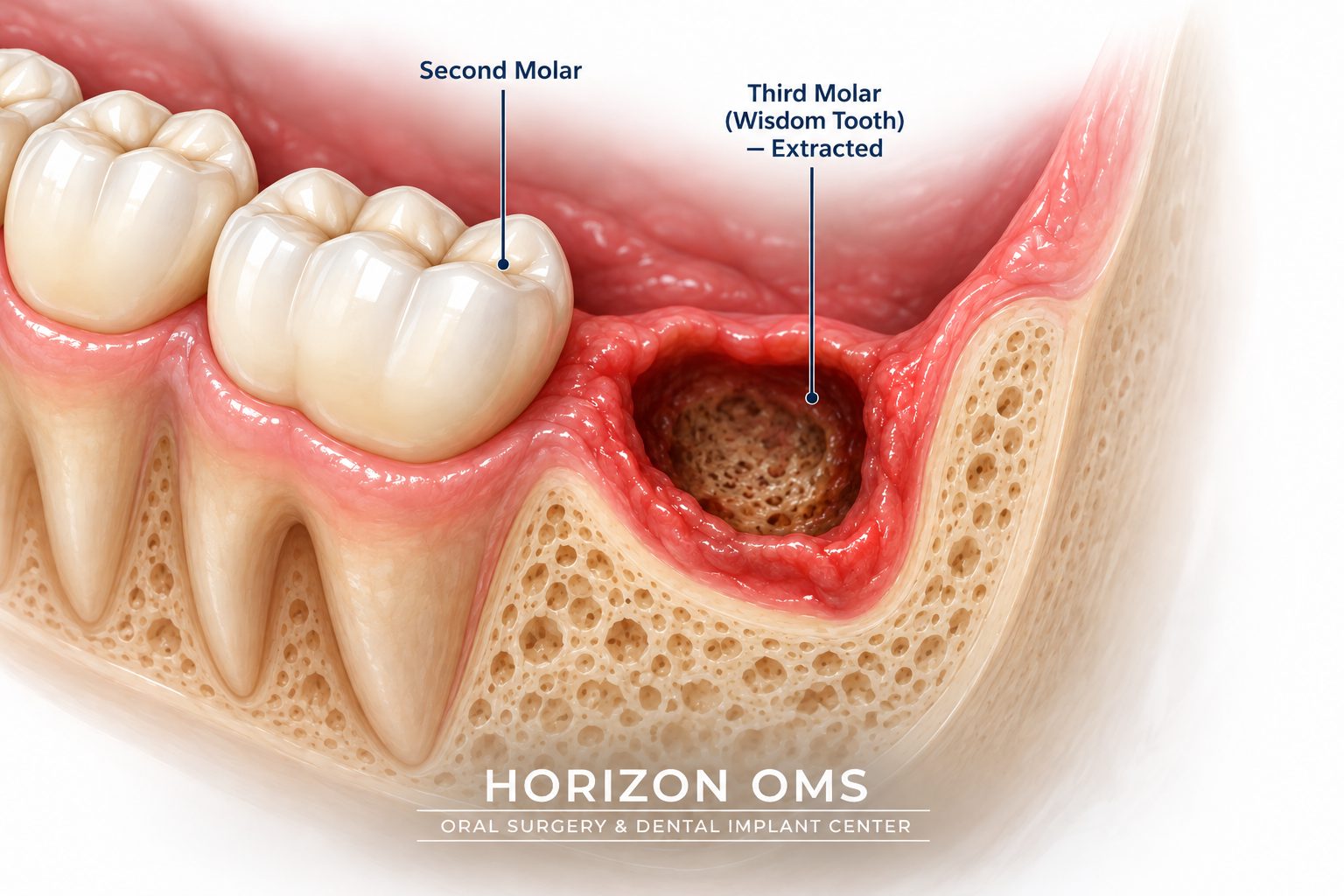
What is dry socket?
Dry socket — clinically known as alveolar osteitis — is a post-operative complication that can develop after a dental extraction, most frequently associated with lower third molars (wisdom teeth). It occurs when the blood clot that normally forms in the extraction socket after surgery either fails to develop or becomes dislodged, leaving the underlying bone exposed to the oral environment.
Think of the blood clot the way you would think of a scab on your skin after a cut — it protects the underlying tissue while it heals. When that clot is lost, the exposed bone becomes an open wound that is painful and slow to heal on its own.
Incidence varies significantly by which tooth is involved: 1–4% for routine extractions overall, but as high as 45% for impacted mandibular third molars. Lower teeth are approximately 10× more likely to develop dry socket than upper teeth.
How to spot it: signs and symptoms
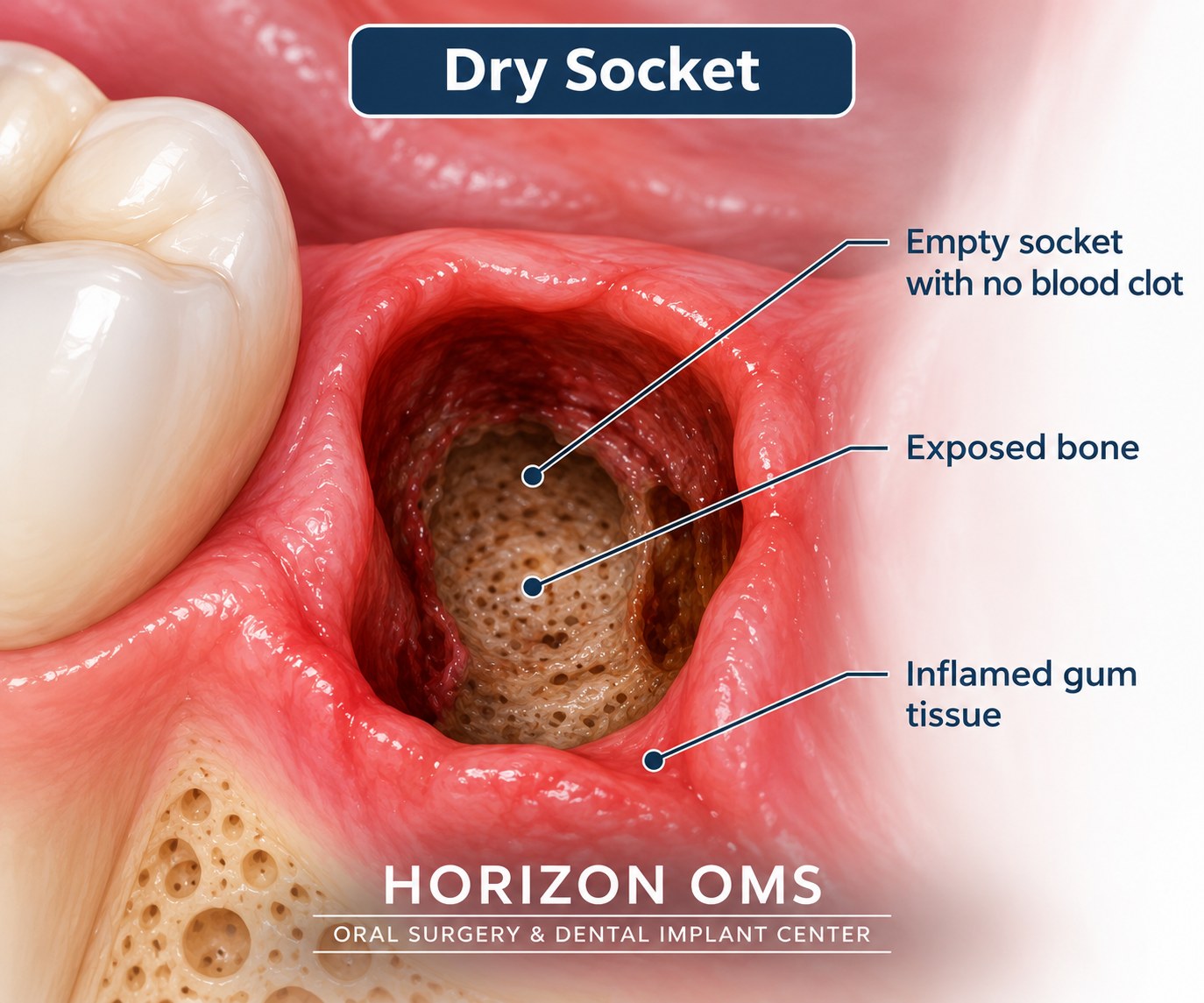
Dry socket classically presents 3 to 5 days after surgery — sometimes as late as day 7 — after an initially uneventful post-operative period. The onset is often distinct: the patient feels progressively better for the first two days, then wakes up on day 3, 4, or 5 with new, severe pain.
Classic signs of dry socket:
- A dull, deep, throbbing pain at the extraction site that radiates to the ear, jaw, or neck on the affected side
- Pain that does not respond to standard pain medications, including ibuprofen, acetaminophen, or prescription analgesics
- Pain that appears or worsens after an initial period of improvement
- A bad taste or foul odor in the mouth
- Visible exposed bone within the socket, or absence of the normal dark clot
- Mild swelling of surrounding gum tissue; occasionally, tender lymph nodes on the affected side
What dry socket is not:
- Normal post-operative discomfort — which should improve progressively day over day.
- A wound infection — which presents with fever, purulent (pus) discharge, or systemic symptoms and requires different treatment.
If you have had a wisdom tooth or lower molar extracted and are experiencing worsening pain 3–7 days after surgery that does not respond to your prescribed pain medication, call our office at (630) 425-2555.
Risk factors and causes
The exact mechanism of dry socket is multifactorial — but a well-established set of risk factors has been identified.
Behavioral factors (patient-modifiable)
- Smoking or vaping — the single most significant modifiable risk factor. Both the chemical exposure and the suction action of inhaling contribute to clot loss.
- Drinking through straws in the first 72 hours after surgery
- Vigorous rinsing or spitting during the first 24–48 hours
- Poor oral hygiene before or after the procedure
- Aggressive tongue or finger manipulation of the extraction site
Physiological factors
- Oral contraceptive use — estrogen affects local fibrinolysis (clot breakdown). Scheduling elective extractions during the last week of the OCP cycle (days 22–28) can reduce risk.
- Age — most commonly seen in patients between 40 and 45 years old.
- Prior history of dry socket — recurrence risk is meaningfully elevated.
- Female sex — partly attributable to OCP use, partly independent.
Surgical factors
- Extraction complexity — longer, more traumatic procedures increase risk.
- Impacted or partially erupted teeth — approximately 69% of dry socket cases involve partially erupted teeth.
- Pre-existing infection such as pericoronitis around the tooth being removed.
- Anatomic location — lower teeth carry ~10× the risk of upper teeth, and mandibular third molars carry the highest risk of any extraction site.
Prevention — the best treatment
There is no single treatment proven to reliably resolve dry socket once it occurs. This makes prevention the most important intervention.
What patients can do
- Do not smoke or vape for at least 72 hours after surgery — ideally longer.
- Follow all post-operative instructions provided by your surgical team. See our detailed after-surgery instructions.
- Avoid straws, spitting, and vigorous rinsing for the first 24–48 hours.
- Maintain gentle oral hygiene as directed.
- Take all prescribed medications as scheduled — do not skip doses because pain has improved.
What your surgeon can do
- Atraumatic extraction technique — minimizing surgical trauma reduces both post-operative pain and dry socket risk.
- Thorough intraoperative irrigation to remove debris and reduce bacterial load.
- Placement of Platelet-Rich Fibrin (PRF) directly into the socket when indicated — a clinically supported method for reducing dry socket incidence and accelerating soft-tissue healing. Learn more about PRF and its applications.
- Chlorhexidine mouth rinses in selected cases, typically starting 24 hours after surgery.
- Topical antibiotic placement for higher-risk patients — combination chlorhexidine + metronidazole gels have shown particular promise, reducing dry socket incidence from 22.6% to 6.6% in one randomized trial.
- Systemic antibiotic prophylaxis reserved for select high-risk cases (immunocompromised patients, extensive surgery, or pre-existing infection). Meta-analytic evidence supports metronidazole in reducing overall alveolar osteitis incidence.
At Horizon OMS, we offer PRF placement as part of our extraction protocols when indicated, based on each patient's individual risk profile and the specifics of the surgery.
Treatment and management
If dry socket does develop, treatment focuses on pain control and creating a favorable environment for the socket to heal. The bone and soft tissue will regenerate on their own — the goal of treatment is to make the healing period tolerable and shorten the duration of symptoms.
In-office management typically includes:
- Gentle saline irrigation of the socket to remove food debris and inflammatory byproducts.
- Placement of a medicated sedative dressing in the socket — most commonly a eugenol-based (clove oil derivative) preparation such as Alvogyl (iodoform + butylparaminobenzoate + eugenol). Patients typically feel meaningful pain relief within minutes.
- Follow-up dressing changes every 24–48 hours until symptoms resolve — typically 2 to 4 additional visits over 5 to 10 days.
- Pain management guidance — usually a combination of scheduled NSAIDs and acetaminophen, timed around the clock rather than taken only as needed.
The role of antibiotics — what the evidence shows
Antibiotics are not routinely required for dry socket, since it is not primarily an infectious process. However, metronidazole (Flagyl) has meaningful clinical evidence supporting its use in selected cases:
- A clinical study demonstrated that systemic metronidazole provided early relief of pain when administered in the treatment of established dry socket.
- A meta-analysis of 16 randomized controlled trials involving 2,932 patients found that systemic antibiotic therapy reduced dry socket incidence from 14.4% to 6.2% (odds ratio 2.175), with a number needed to treat of 13.
- A 2024 systematic review and meta-analysis of 11 studies confirmed that metronidazole significantly favored better wound healing (RR 0.25, 95% CI 0.12–0.52).
When we consider systemic antibiotics for dry socket: concurrent infection, immunocompromised patients, extensive or complex surgical cases, and symptoms that persist despite adequate local therapy. Antibiotics are an adjunct to — not a substitute for — local irrigation and dressing management.
At-home care while the socket heals
- Continue gentle warm saltwater rinses starting 24 hours after your dressing is placed.
- Strictly avoid smoking, vaping, straws, and vigorous rinsing.
- Take medications as directed — scheduled, not just as needed.
- Return for all scheduled dressing changes.
- Eat soft, cool foods and stay well-hydrated.
When to call our office
Contact Horizon OMS as soon as possible if you experience any of the following after an extraction:
- Severe, throbbing pain 3–7 days after extraction that is unrelieved by prescribed medication
- Foul taste or odor coming from the extraction site
- Visible exposed bone or absence of a clot in the socket
- Any concerning post-operative symptoms that don't feel like normal healing
Phone: (630) 425-2555
Address: 6 E St. Charles Rd, Lombard, IL 60148
For after-hours emergencies, visit our Emergency Oral Surgery page.
Related resources
- After-Surgery Instructions — general post-operative care guidance
- Wisdom Teeth Extraction — the procedure most associated with dry socket
- PRF (Platelet-Rich Fibrin) — how PRF placement can reduce dry socket risk
- Patient Resources — downloadable post-operative guides and handouts
- Emergency Oral Surgery — for urgent post-op concerns
Frequently asked questions
How long does dry socket last?
With in-office treatment, symptoms typically resolve within 5–10 days. Without treatment, discomfort may persist for 10–14 days, and full soft-tissue healing usually completes within 3–4 weeks regardless.
Is dry socket dangerous?
Dry socket is very painful but not medically dangerous. It does not typically spread infection and rarely causes lasting complications when properly managed.
Can dry socket heal on its own?
Yes, but healing without treatment is prolonged and considerably more painful. In-office treatment with irrigation and a medicated dressing dramatically reduces pain and shortens the timeline to comfortable healing.
Will I need antibiotics for dry socket?
Not routinely. Dry socket is not primarily an infectious process. Systemic antibiotics — most commonly metronidazole — are reserved for select situations such as concurrent infection, immunocompromised patients, or symptoms that persist despite adequate local therapy.
When after a tooth extraction can dry socket occur?
Dry socket most commonly appears 3–5 days after extraction, sometimes as late as day 7. It cannot develop once the socket has filled in with granulation tissue, which typically occurs within about two weeks.
Why is dry socket more common with wisdom teeth?
Lower third molar extractions are approximately 10× more likely to develop dry socket than upper extractions. Contributing factors include denser mandibular bone, gravity's effect on clot retention, generally longer surgical times, and the frequent presence of partially erupted or impacted teeth.
Does insurance cover dry socket treatment?
Coverage varies by plan. Contact our office for questions about your specific coverage — we can provide a treatment estimate and help you understand what to expect.
References
- Blum IR. Contemporary views on dry socket (alveolar osteitis): a clinical appraisal of standardization, aetiopathogenesis and management. Int J Oral Maxillofac Surg. 2002;31(3):309–317.
- Bergdahl M, Hedström L. Metronidazole for the prevention of dry socket after removal of partially impacted mandibular third molar: a randomised controlled trial. Br J Oral Maxillofac Surg. 2004;42(6):555–558.
- Halabí D, Escobar J, Muñoz C, Uribe S. Logistic regression analysis of risk factors for the development of alveolar osteitis. J Oral Maxillofac Surg. 2012;70(5):1040–1044.
- Ren YF, Malmstrom HS. Effectiveness of antibiotic prophylaxis in third molar surgery: a meta-analysis of randomized controlled clinical trials. J Oral Maxillofac Surg. 2007;65(10):1909–1921.
- Sindet-Pedersen S, Torbjørn F. Metronidazole in the treatment of "dry socket." Int J Oral Surg. 1981;10(3):173–176.
- Torres-Lagares D, et al. Repercussions of intraalveolar placement of chlorhexidine + metronidazole gel on the occurrence of dry sockets — a randomised control trial. Med Oral Patol Oral Cir Bucal. 2017.
- Metronidazole for the Prophylaxis of Alveolar Osteitis: A Systematic Review and Meta-analysis. J Maxillofac Oral Surg. 2024.
This page is for educational purposes and does not substitute for individualized clinical advice. Reviewed by Ali Al-Qudsi, DMD, FAAOMS.