
Full-arch implant options
Implant-Supported Overdentures
A removable “snap-in” denture retained by dental implants—planned with your restoring dentist for greater stability, confidence, and function.
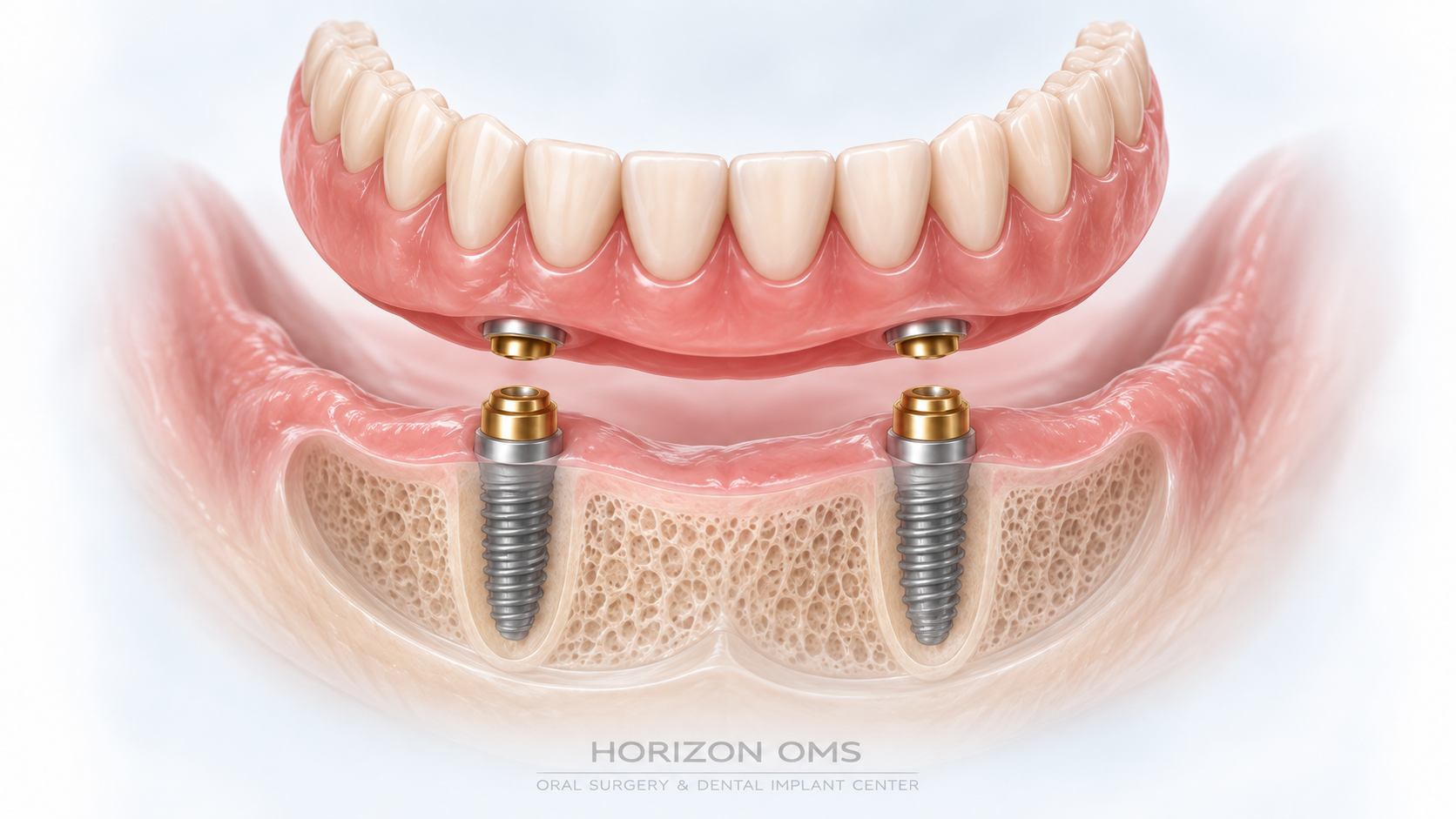
What is an implant-supported overdenture?
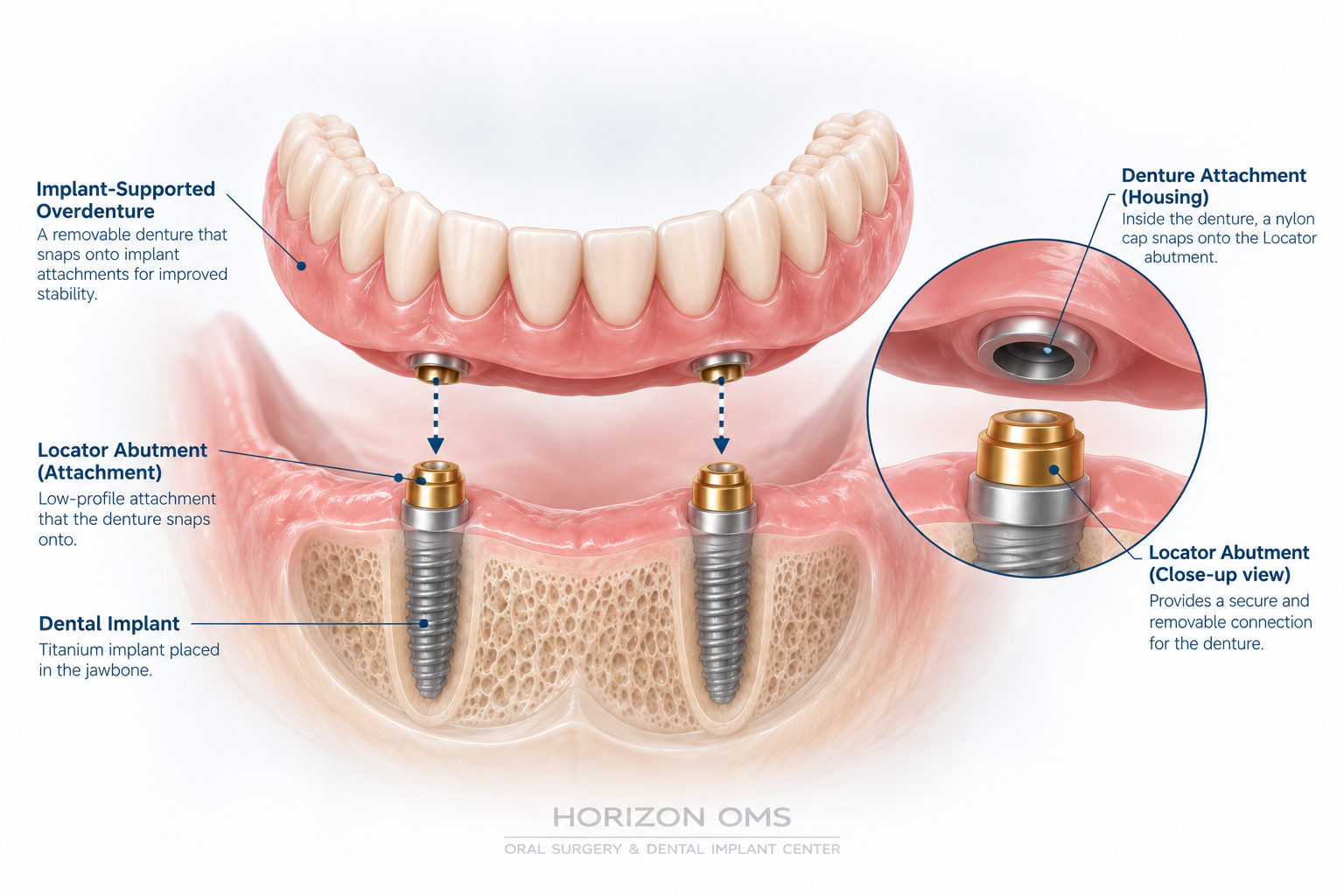
An implant-supported overdenture is a full-arch denture that connects to dental implants placed in the jaw. You may also hear it called an implant-retained denture, implant-stabilized denture, or snap-in denture. Unlike a conventional denture that rests only on the gums, the overdenture connects to implant attachments for additional retention and support.
Most overdentures are removable by the patient. They are designed to come out for thorough daily cleaning and usually at night. Depending on the restorative plan, the denture may connect directly to individual implant attachments or to a bar supported by several implants.
Horizon OMS performs the surgical and implant portion of care. Your restoring or general dentist plans, makes, fits, and maintains the denture, teeth, and attachment system. We do not manufacture the denture or replacement teeth. We coordinate implant position, timing, and healing closely with your dentist so the surgical foundation supports the planned prosthesis.
How overdentures compare with other full-arch options
Conventional dentures
A conventional complete denture rests on the gums and underlying ridge without implant support. Adhesive may help, but movement can still occur—particularly with a lower denture. An implant-supported overdenture uses implant attachments to improve retention, which may reduce lifting, rocking, or sliding. It remains removable and still needs routine adjustment as the mouth changes.
Fixed All-on-4 / All-on-X teeth
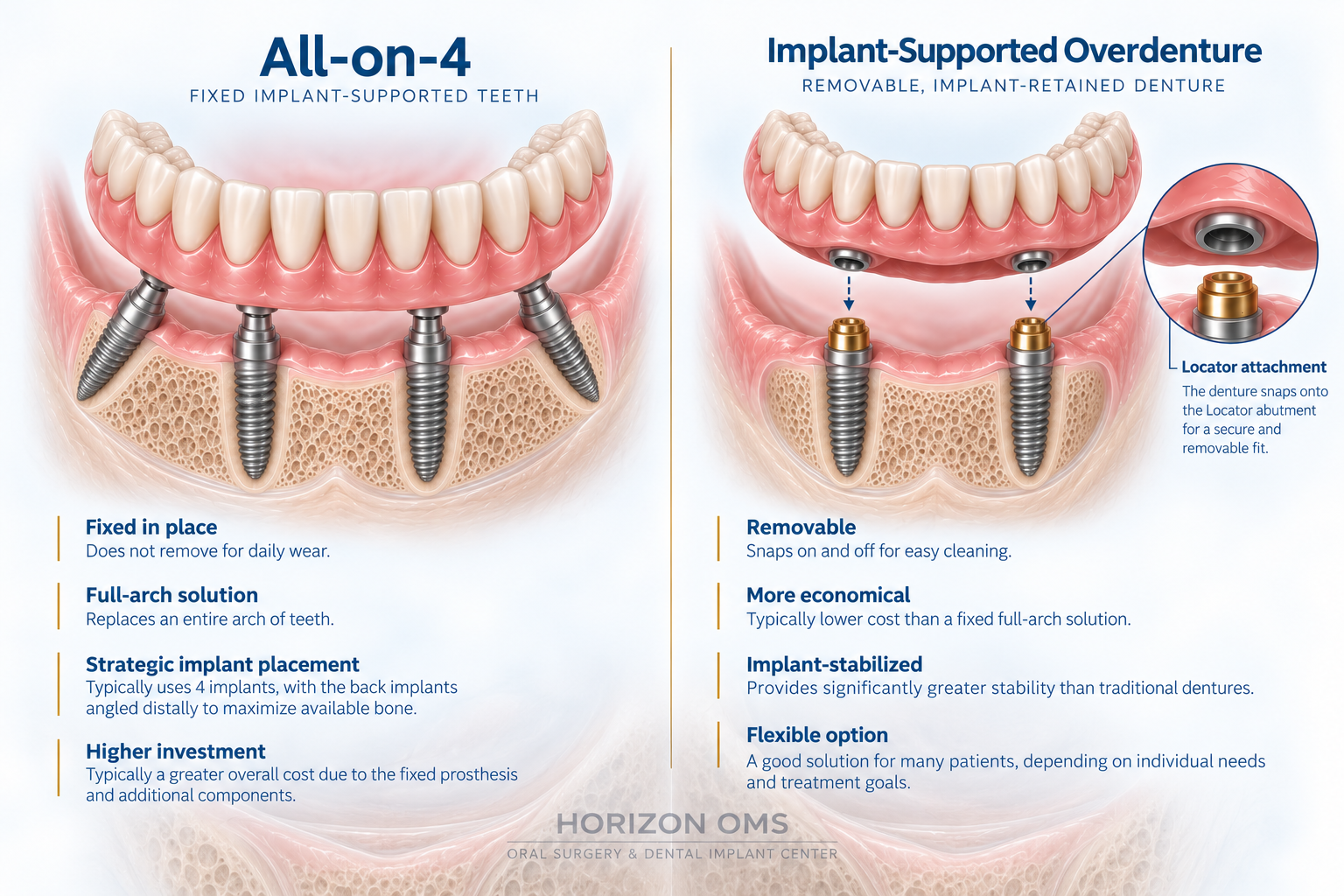
All-on-X implant surgery generally supports a fixed full-arch bridge that a patient does not remove at home. “All-on-4” is one common All-on-X configuration; the actual number of implants may vary. A removable overdenture typically uses a different prosthetic design and attachment system, may use fewer implants, and comes out for cleaning.
- Removability: an overdenture is usually removed by the patient; an All-on-X bridge is fixed and is removed only by a dental professional when necessary.
- Feel and space: an overdenture often has more acrylic and may cover part of the palate in the upper jaw; a fixed bridge generally feels more like teeth but requires room beneath it for hygiene.
- Maintenance: overdenture attachments and inserts can wear and need replacement; fixed bridges require specialized daily cleaning underneath and periodic professional maintenance.
- Treatment investment: when clinically appropriate, a removable implant-retained overdenture can be a more economical full-arch implant option than a fixed All-on-X bridge. Fees vary by the number of implants, extractions, grafting, anesthesia, attachment design, and restorative work.
Neither approach is universally better. The right option depends on your anatomy, health, hand function, hygiene ability, restorative space, expectations, and budget. We help you and your restoring dentist understand the tradeoffs before treatment begins.
Potential benefits
- Improved denture retention and stability compared with a conventional denture
- Less reliance on denture adhesive for many patients
- Greater confidence while speaking and eating
- A removable design that can be taken out for direct cleaning
- Implants that help preserve bone in the areas where they are placed
- A potentially more economical implant-retained full-arch option than fixed All-on-X treatment when appropriate
- Restorative components that can often be repaired, relined, or replaced without replacing the implants
Limitations and tradeoffs
- The denture is still removable and may have some movement under chewing forces.
- Upper overdentures may still cover part of the palate, depending on implant number and design.
- Attachment inserts wear over time and commonly require periodic replacement by the restoring dentist.
- The denture base may need adjustment or relining as gum and bone contours change.
- Implants and surrounding tissues can develop inflammation or bone loss without careful hygiene and maintenance.
- Implant placement involves surgery, healing time, and the possibility that grafting or staged care will be recommended.
Who may be a candidate?
Implant-supported overdentures may be considered for patients who are missing all teeth in one or both jaws, have a loose or uncomfortable conventional denture, or need removal of failing teeth and want more retention than a traditional denture can provide. Good candidates must be healthy enough for implant surgery and able to maintain the implants and prosthesis.
We evaluate:
- Bone volume and quality, including nerve and sinus anatomy
- Gum health, smile and lip support, bite, and available restorative space
- Current teeth, infection, and whether non-wisdom tooth extractions are needed
- Medical history, medications, tobacco use, and conditions that may affect healing
- Ability to remove, clean, and reinsert the denture
- Your priorities for stability, removability, maintenance, timing, and overall treatment investment
How many implants are needed?
There is no single implant number for every overdenture. Some lower-jaw designs use two implants, while other lower or upper overdentures use additional implants or a connecting bar. The upper jaw often requires a different approach because its bone quality, anatomy, and load distribution differ from the lower jaw.
The number and location should be determined after the denture design is planned. Horizon OMS and your restoring dentist coordinate before surgery so implants are placed where they can support the selected attachments and planned tooth position.
Typical treatment sequence
- Restorative and surgical consultation: We review your goals, health history, teeth, denture experience, and alternatives. Your restoring dentist evaluates the proposed denture design.
- 3D imaging and coordinated planning: When appropriate, CBCT imaging helps assess bone, nerves, sinuses, and implant positions. Our team confirms the surgical plan with your restoring dentist.
- Extractions or site preparation: Failing teeth are removed when needed. Bone grafting may be recommended depending on anatomy and implant timing.
- Implant surgery: Horizon OMS places the planned implants. In selected cases, teeth can be removed and implants placed during the same visit; other cases are safer or more predictable when staged.
- Healing and integration: The implants are allowed to bond with the bone. A healing denture may be worn with adjustments and diet restrictions as directed.
- Restorative connection: After the implants are ready, your restoring dentist makes or modifies the denture and connects its attachments to the implants.
- Ongoing maintenance: Your dentist monitors fit, bite, attachments, and hygiene. Horizon OMS remains available for surgical follow-up and implant concerns.
Extractions, grafting, and timing
If teeth remain, dental extractions may be part of the plan. Implants can sometimes be placed at the extraction visit, but immediate placement is not automatic. Infection, bone shape, implant stability, medical factors, and the planned denture all influence timing.
Some patients need bone grafting to create better implant support; others do not. The goal is not to add procedures unnecessarily, but to build a stable, maintainable foundation for the prosthesis your dentist has planned.
Comfort and anesthesia
Local anesthesia is used for implant surgery. Depending on your health, preferences, and procedure complexity, IV sedation may also be available for a more relaxed experience. We review your medical history and medications before recommending an individualized anesthesia plan.
Recovery and when the denture can connect
Swelling, soreness, minor bleeding, and temporary diet changes are common after implant placement or extractions. Many patients return to routine non-strenuous activities within a few days, but recovery varies with the extent of surgery.
The denture may need to be adjusted so it does not place harmful pressure on healing sites. Implants generally need time to integrate before they carry full attachment forces. Immediate or early connection is possible only in selected situations with appropriate implant stability and restorative planning. Your surgeon and restoring dentist will coordinate the safest timing.
Daily care and long-term maintenance
- Remove and clean the overdenture exactly as directed by your restoring dentist.
- Clean around each implant, attachment, or bar every day with the recommended brush and hygiene tools.
- Do not sleep in the denture unless your dental team specifically advises it.
- Keep regular visits with your restoring dentist for professional cleaning, bite and fit checks, and attachment maintenance.
- Report looseness, sore spots, broken components, bleeding, swelling, or persistent discomfort promptly.
- Avoid tobacco; it raises the risk of poor healing and implant complications.
Implants are not cavity-prone, but the tissue and bone around them can become inflamed. Long-term success depends on home care, professional maintenance, medical factors, bite forces, and consistent follow-up.
Understanding treatment costs
An implant-supported overdenture can be more economical than a fixed full-arch All-on-X restoration in appropriate cases, but there is no universal price. The surgical fee depends on implant number, imaging, extractions, grafting, and anesthesia. The restorative fee depends on the denture, laboratory work, attachments, and follow-up provided by your restoring dentist.
Because two offices may be involved, you may receive separate treatment plans or estimates for the surgical and restorative phases. Horizon OMS will explain our portion and coordinate with your dentist so you understand the complete sequence before proceeding.
We diagnose and plan the surgical component, place the implants, perform extractions or grafting when indicated, provide anesthesia options, and monitor surgical healing. Your restoring dentist provides the denture and replacement teeth, selects and services the attachment system, manages the bite, and performs long-term prosthetic maintenance. If you do not have a restoring dentist, we can recommend trusted restorative colleagues and coordinate your care.
Implant overdenture consultations in Lombard, Illinois
Horizon OMS of Chicago provides implant surgery and coordinated full-arch planning in Lombard for patients throughout Chicago’s western suburbs, including Elmhurst, Glen Ellyn, Downers Grove, Villa Park, Addison, Oak Brook, Oakbrook Terrace, Hinsdale, Westmont, Darien, and Wheaton.
To discuss whether a conventional denture, implant-supported overdenture, or fixed All-on-X restoration may fit your needs, request a consultation or call (630) 425-2555.
Coordinated implant care
Your dentist designs and delivers the overdenture. Horizon OMS places the implants and manages the surgical phase.
Book Consultation